.png)
How Clinical Training Works During MBBS in Armenia
Clinical training in Armenia is an important part of medical education because it helps students connect classroom knowledge with real healthcare practice. For students planning to study MBBS in Armenia, understanding how clinical training is organised can help them make a more informed decision about their medical education.
In Armenia, clinical education structures can vary between universities. However, medical programmes generally combine theoretical learning with practical and clinical education. For example, Armenian-Russian International University describes a six-year integrated General Medicine programme that includes clinical subjects, practical training, simulation-based learning, hospitals, outpatient clinics, and clinical laboratories.
Clinical training is not limited to observing doctors. Depending on the year of study and university curriculum, students may develop practical skills, participate in supervised clinical activities, study different medical specialties, and receive assessments of their clinical competencies.
Understanding Clinical Training During MBBS in Armenia
Before considering a detailed description of the annual program, it is important to clarify what exactly clinical training entails and why a six-year program of study is designed around it by all medical schools. The Armenian educational framework of the medical field is governed by the Ministry of Education, Science, Culture and Sport of the country, while MGARIU also holds international recognition, such as that from WHO and the NMC of India.
What Does Clinical Training Mean for Medical Students?
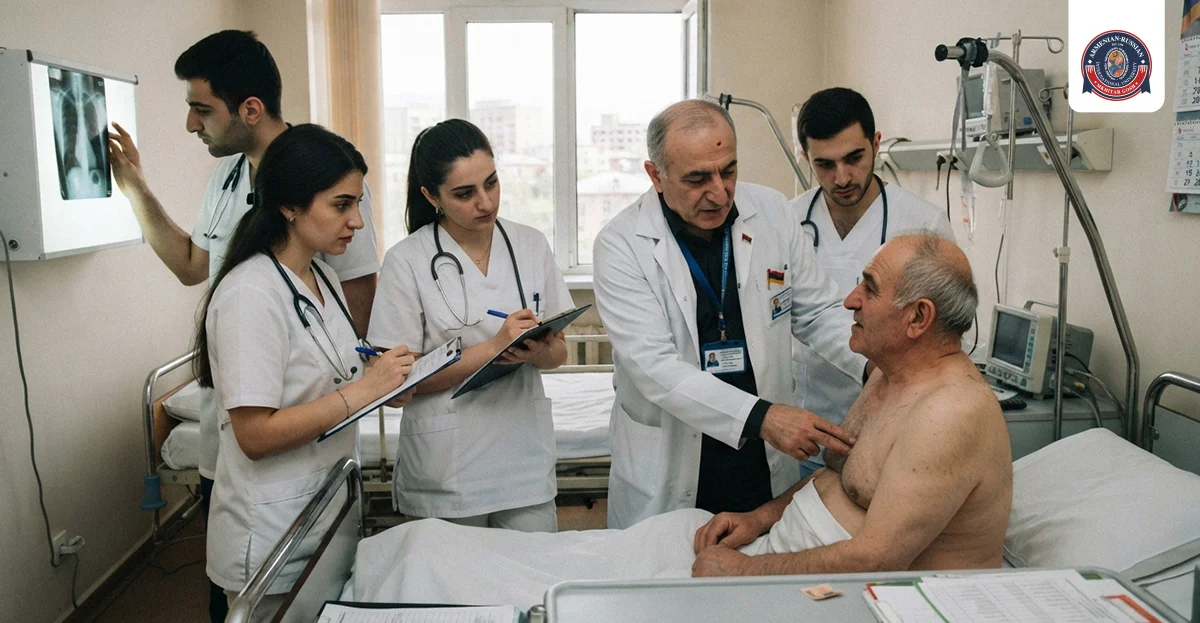
Clinical training allows medical students to apply medical knowledge in healthcare settings. It may include learning how hospitals and outpatient facilities function, developing practical skills, studying patient cases, and participating in supervised clinical activities.
At MGARIU, for example, practical training is an integrated component of the General Medicine programme, and students receive defined practical-training requirements and supervision.
Why Clinical Exposure Matters During Medical Education
Classroom learning provides the scientific foundation of medicine, while clinical exposure Armenia helps students understand how that knowledge is applied to patients.
Through clinical education, students can develop skills related to:
- Patient communication
- Medical history taking
- Physical examination
- Clinical reasoning
- Practical procedures
- Case discussion
- Professional conduct
When Does Clinical Training Start During MBBS in Armenia?
Students who study MBBS in Armenia often assume clinical work begins abruptly partway through the course. In practice, most universities phase it in gradually, so that by the time students reach full hospital rotations, they've already built a foundation of basic skills and hospital familiarity. For the complete picture of how these years fit into the wider MBBS curriculum structure, see our detailed breakdown of the academic program.
Early Years: Building Basic Clinical Skills
Students may begin with first aid, basic clinical skills, and an introduction to healthcare institutions. At MGARIU, the first-year curriculum includes First Aid with Clinical Skills and Practical Skills, while practical training formally begins in the second year.
Year 2: Introduction to Healthcare Settings
Practical training at MGARIU’s General Medicine programme includes an introduction to the organisation and structure of hospitals and outpatient care settings during the second year.
Year 3: Nursing and Early Clinical Practice
The third year includes clinical subjects such as Propaedeutics of Internal Medicine and General Surgery, alongside practical training as a nursing assistant in the MGARIU programme.
Years 4 and 5: Increasing Clinical Responsibility
As students progress, clinical exposure becomes broader. MGARIU lists practical training involving assistant roles in areas such as family medicine, surgery, obstetrics and gynecology in Year 4, followed by physician-assistant roles in Year 5.
How Clinical Rotations Work in Armenian Medical Universities
Clinical training is delivered mainly through rotations, fixed periods spent in one department before moving to the next. Here's how that system generally works. For more on how this looks day-to-day, including simulation labs and hospital-based learning, see our dedicated guide to clinical training and hospital exposure at MGARIU.
What Is a Clinical Rotation?
A clinical rotation is a period of structured learning in a particular medical department or specialty. It allows students to study clinical conditions and understand how healthcare professionals approach diagnosis, treatment, and patient care.
How Students Move Between Medical Departments
The range of departments depends on the university's curriculum. MGARIU's General Medicine curriculum includes specialties such as internal medicine, surgery, pediatrics, obstetrics and gynecology, neurology, ophthalmology, ENT, psychiatry, infectious diseases, and several other clinical disciplines.
How Students Are Supervised
Clinical learning is conducted under the direction of academic and clinical professionals. MGARIU states that clinical courses are taught by faculty members who are practising doctors, while practical training is supervised through designated clinical institutions.
Which Clinical Departments Do MBBS Students Study?
Depending on the university programme, students may receive MBBS clinical training in areas such as:
- Internal Medicine
- General Surgery
- Pediatrics
- Obstetrics and Gynecology
- Neurology
- Neurosurgery
- Ophthalmology
- ENT
- Psychiatry
- Dermatology
- Infectious Diseases
- Orthopedics and Traumatology
- Emergency and Intensive Care
- Family Medicine
For example, these areas appear across different years of MGARIU's published General Medicine curriculum.
What Do Students Actually Do During Clinical Training?
Clinical training for the students represents the first step in transforming theoretical knowledge into practical skills. Depending on the institution, students will be allowed to examine patients in a supervised setting, engage in discussions about clinical cases, perform procedures using simulations, and gain more clinical duties.
Learning Through Patient Cases
Clinical education can involve the examination and discussion of patients and clinical cases. MGARIU's Department of Propaedeutics of Internal Diseases states that patient examinations and clinical case discussions are organised for students during training.
Developing Practical Clinical Skills
Students can also practise clinical skills in simulation environments before or alongside clinical exposure. MGARIU's Simulation Training Centre provides training in areas including resuscitation and intensive care, obstetrics and gynecology, pediatrics and surgery.
Working Under Supervision
Students should not be presented as independent doctors during undergraduate clinical training. Practical activities are performed according to the curriculum and under appropriate supervision. MGARIU's practical-training framework, for example, specifies supervised patient examination and defined practical activities.
Where Does Clinical Training Take Place in Armenia?
Students who want to pursue their medical studies in Armenia will find that the process of clinical education does not necessarily involve only the classroom. Clinical education will vary from institution to institution and may include simulation centres, university hospitals, outpatient clinics, and other healthcare facilities.
University Hospitals and Teaching Clinics
Clinical education may take place in university hospitals and affiliated healthcare institutions.
Outpatient Clinics and Laboratories
Clinical teaching can also involve outpatient facilities and clinical diagnostic laboratories. MGARIU specifically identifies university hospital complexes, outpatient clinics, clinical diagnostic laboratories and other medical institutions as clinical teaching locations.
Simulation and Skills Centres
Simulation centres provide students with an environment in which practical skills can be developed before or alongside patient-based learning.
How Is Clinical Performance Assessed?
For students, clinical assessment is not limited to written examinations; it can also measure how effectively they apply medical knowledge and demonstrate practical clinical skills.
Practical Skills Assessment
Clinical education may include assessment of practical competencies. MGARIU states that assessment for clinical courses extends to practical competencies and that practical skills have been assessed using an OSCE format.
Practical Training Reports
Practical training may also involve documentation of completed activities. At MGARIU, students receive practice report sheets outlining required activities and procedures, which are reviewed by the clinical supervisor after completion.
Clinical Training During MBBS in Armenia: Year-Wise Overview
|
Study Stage |
Example of Clinical Development |
|
Year 1 |
First aid and basic clinical skills |
|
Year 2 |
Introduction to hospitals and outpatient settings |
|
Year 3 |
Nursing-related practical training and early clinical subjects |
|
Year 4 |
Major clinical subjects and supervised assistant training |
|
Year 5 |
Wider specialty exposure and physician-assistant training |
|
Year 6 |
Advanced clinical subjects and professional preparation |
This table reflects the progression published by MGARIU and should not be treated as a universal curriculum for every medical university in Armenia.
What Should Indian Students Check Before Choosing an MBBS University in Armenia?
Students should look beyond tuition fees and ask about the university's actual clinical-training arrangements. Important points to verify include:
- Teaching hospitals and clinical affiliations
- Clinical rotation structure
- Patient exposure
- Practical-skills facilities
- Simulation-based training
- Supervision arrangements
- Language used during clinical education
- Practical-training requirements
- Internship structure
- Current eligibility and regulatory requirements for Indian students
Conclusion
Clinical training in Armenia is not a one-time event but an ongoing process that begins with acquiring basic skills through simulation in Year 1 and continues all the way until near-independence and intense supervision in Year 6. Every level builds upon the previous one: hospital orientation, rotating department-wise, case analysis, and, ultimately, clinical decision-making, which will be needed to pass licensing examinations and to actually work as a doctor.
This aspect of Armenian medical training can be used to convince Indian students who compare studying medical education Armenia with other countries. To see how this is implemented in practice at Mkhitar Gosh Armenian-Russian International University, you should visit the MBBS admission process or contact the admission office regarding rotations currently taking place.
FAQs
When does clinical training start in Armenia?
The timing varies by university. Some programmes introduce practical and clinical skills early and progressively increase clinical training in later years. MGARIU, for example, includes practical training from Year 2.
Do MBBS students get hospital exposure in Armenia?
Yes, medical programmes can include hospital and outpatient clinical education. The exact institutions and exposure depend on the university.
What clinical subjects are taught during MBBS in Armenia?
Clinical subjects can include internal medicine, surgery, pediatrics, obstetrics and gynecology, neurology, psychiatry, ophthalmology, ENT, and other specialties, depending on the university curriculum.
Is clinical training supervised?
Clinical training is structured and supervised according to the university's programme. MGARIU, for example, identifies supervisors for practical training and practising doctors among its clinical teaching staff.
How are clinical skills assessed?
Assessment methods vary by programme, but can include practical competency assessments, examinations and clinical skills assessments. MGARIU has reported OSCE-based practical skills assessment